Resetting the Line in Surf Spey

By Mark Severino

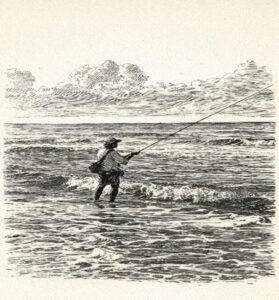
Surf currents pull the line down‑the‑beach and collapse the geometry required for a Spey cast. In the surf, the caster must deliberately restore the forward casting plane before any lift, sweep, or delivery can occur. Surf Spey uses fast, repeatable resets designed specifically for lateral tension and collapsing geometry.

Line‑Setting Movements, Lift and Flip, Lift and Roll, or Roll Cast

Surf currents collapse geometry and pull the line out of the forward casting plane. The caster restores that plane using one of three line‑setting movements:

Lift and Roll (Casting‑Shoulder Side) – used when the surf drags the line down‑the beach toward the casting shoulder. The caster lifts and rolls the line forward, forming an aerialized loop, driving the line straight ahead to restore tension and alignment.

Lift and Flip (Off‑Casting Shoulder) – used when the surf drags the line down‑the beach toward the off‑casting shoulder. This is the mirror of the Lift and Roll; the loop forms on the off‑shoulder side and is driven forward to straighten the line and rebuild the forward casting plane.

Roll Cast (Line in Front) — used when the line is directly in front but slack or collapsed. The roll cast straightens the line and restores tension instantly.

Note on Surf‑Spey Lift and Roll, Lift and Flip and Roll Cast, are modified specifically for surf conditions. Each one creates an aerialized loop and then shoots the line straight out in front of the caster to restore the forward casting plane. These are forward‑projecting line‑setters, not direction‑changing casts.

Aerializing the Preset into the Switch Cast

All preset motions can be aerialized directly into a Switch Cast. Once the line is straight and under tension, the caster does not need to pause or let the line settle. The Switch Cast can begin immediately, using the preset’s momentum to lift, sweep, and form the D‑loop in one continuous motion.

Aerializing the preset:

  • eliminates slack before it forms
  • prevents the surf from collapsing the anchor
  • accelerates the transition into the lift and sweep
  • increases tension at the start of the Switch Cast
  • produces a cleaner, faster, higher‑load delivery

The Switch Cast – The Cast After the Reset

Once the line is set, the Switch Cast becomes the first true cast in the sequence. The Switch Cast:

  • lifts
  • sweeps
  • forms the D‑loop
  • and delivers straight ahead

During the lift and sweep, the rod tip travels on a single, unbroken track. Because the line is already straight and under tension, this movement:

  • aligns the line
  • forms the D‑loop instantly
  • and drops the anchor automatically into the correct lane

A Generous Anchor Lane – 48 Inches

Surf‑Spey uses a 48‑inch anchor lane because the surf applies multiple opposing forces the instant the anchor touches water. Waves push the anchor toward the caster, lateral currents drag it down‑the‑beach, and backwash pulls it outward. These forces compress the usable anchor window and constantly try to move the anchor out of position.

A 48-inch anchor lane provides a realistic, stable corridor for the caster, allowing the anchor to land effectively and achieve optimal results.

  • a clean D‑loop
  • a fully loaded rod
  • a straightforward casting plane
  • and maximum distance

A Switch Cast thrown from a straight, tensioned line will always drop the anchor somewhere inside this 48‑inch lane during the lift and sweep. The exact landing point may shift with wave timing, but the lane is wide enough to absorb that movement without compromising geometry or load.

Anchor Management

Once the anchor touches water, the surf immediately begins to interact with it. This is anchor management, and it includes:

  • timing the forward stroke with the wave cycle
  • maintaining tension through the sweep
  • adjusting tempo to match water movement
  • preventing the anchor from skating or burying too deeply

Anchor placement is what the Switch Cast creates. Anchor management is what the surf forces you to do.

Together, they allow the Switch Cast to load the rod fully and deliver maximum distance.

Why This Sequence Produces Maximum Distance

Distance in Surf Spey comes from tension, alignment, and a clean forward-casting plane. A Switch Cast thrown from a straight, tensioned line:

  • drops the anchor in the correct lane
  • forms the D‑loop instantly
  • loads the rod deeper
  • produces a tighter, more stable loop
  • and shoots farther with less effort

Historical Note: The Lift and Flip and Lift and Roll Lineage

Between 1870 and 1890, Spey-casting texts described forward-turning resets using plain physical language: “bring the line round again,” “turn it forward,” “throw it forward smartly,” “send it out straight before you.” These early movements were the functional ancestors of both the Lift and Flip and the Lift and Roll, as well as the Roll Cast.

River casters later evolved these motions into direction‑changing casts like the Single Spey and Snap‑T. But in the surf, where direction change is unnecessary. Geometry collapses rapidly; the original forward‑turning resets, now expressed as surf resets, remain the fastest, cleanest, and most efficient way to restore the casting plane.

Surf Spey is not a new style but a return to the original Spey logic, in which anglers used forward-turning resets to reclaim straight-line tension before every cast. The surf restores the conditions that made those early movements necessary.

Closing Note

These resets are the foundation of Surf‑Spey line control. Every cast begins with geometry, and in the surf, geometry must be reclaimed before it can be used. Once the line is set, the Switch Cast can be performed with full tension and full authority.
 

Fishing in Chile

By Thomas R. Dempsey, M.D. CCI.

I had the opportunity to fish Chile in early April.  What a fascinating country.  The mountains and glacial springs, the glacial waters are everywhere.  The whole country is nothing but mountains and springs.  It is an incredibly clean country.  There’s no trash.  People stop in the streets and pick it up.  What a lesson we could learn in the United States.

We flew into Santiago and spent a day and then went to the camp.  The first camp was called “Magic Waters”.  It was about 2 hours from Santiago on the Simpson River.  Simpson was apparently an explorer in the area many years ago.  Our days were spent fishing in lakes, lagoons, and rivers.  We fished primarily pontoon boats, 2 to a boat.  Our guides were excellent with their knowledge of rivers, flies, and fly fishing in general.  There are pretty much only 2 species of fish in Chile:  Brown Trout and Rainbows.  People go primarily for the big brown trout for aggressive and ready to eat although they are spooky.  A tackle consists of mostly five and six weight rods with 2X and 3x tippet Flies were small terrestrials fished on top.

After spending a week there, we drove to the next camp 5 hours away called the Baker Lodge.  This was on Lago General.  This was a lake that was some 135 miles long. The same deal here…fishing from the boat with small flies on top.

We had the opportunity to fly to the next camp, which was only 45 minutes by air on a helicopter.  We landed on a glacier and were able to take pictures.  What a view!  After fishing Baker Lodge for a week, we headed back to the U.S.  We’ve got to make a book of Chile…we have tons of pictures.  It’s a unique adventure.  Try it!

Casting with Kids

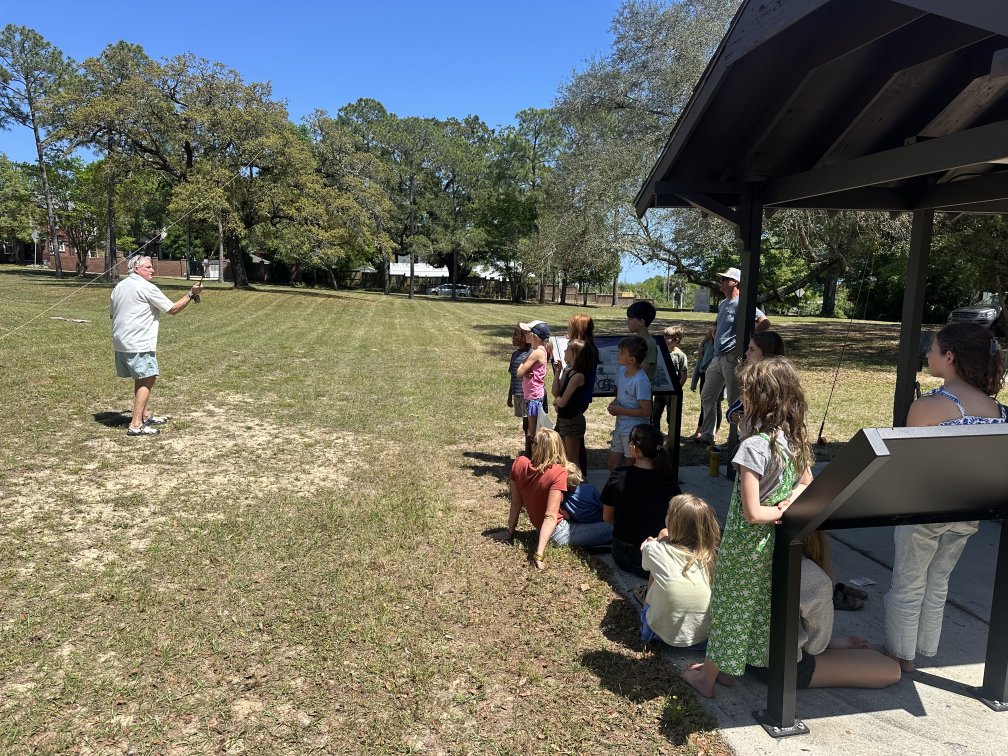
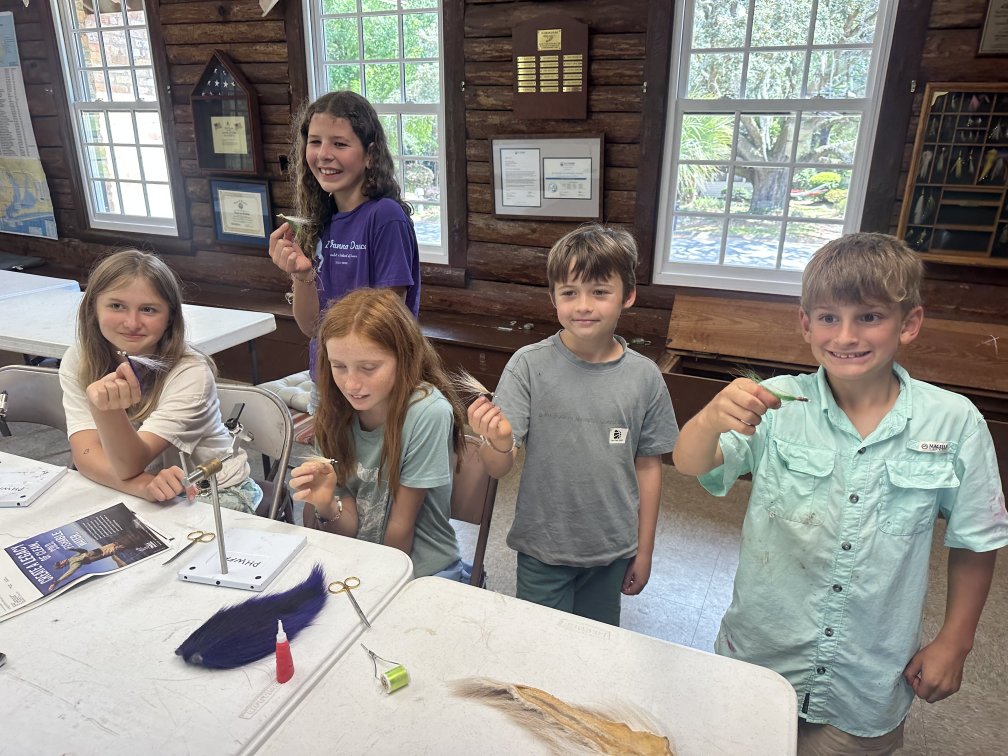
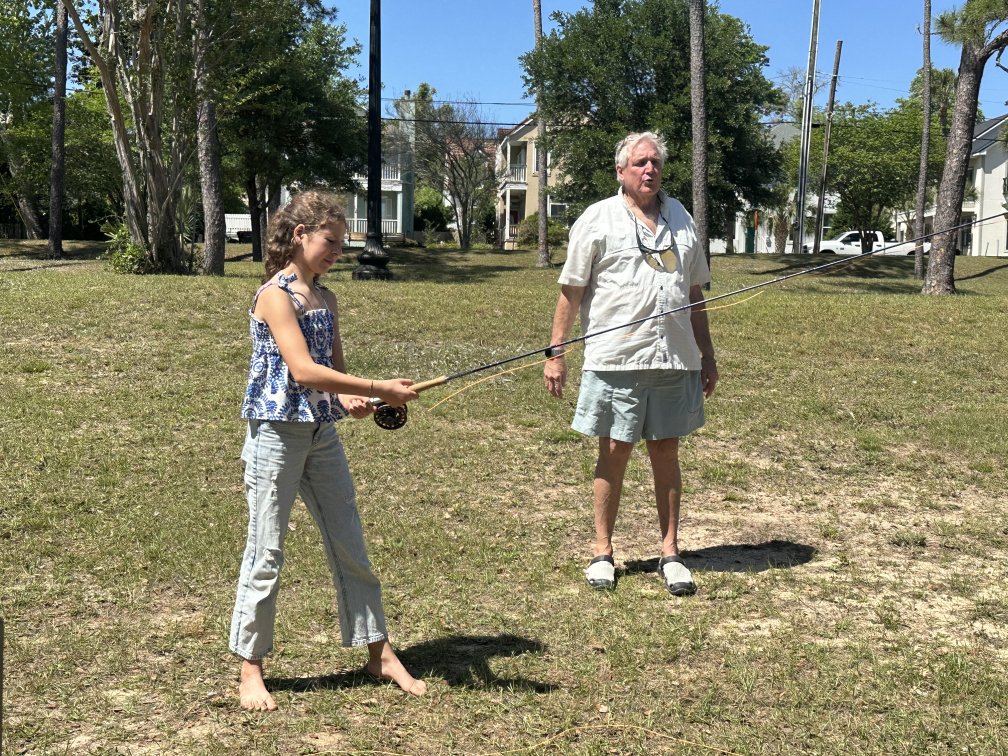
The Gulf Coast Fly Fishing School and Fly Fishing Pensacola Beach were delighted to introduce fly fishing to some 15-year-old kids at the Wild Oaks School in Pensacola.  This past Thursday was their first introduction with fly fishing – some of the terms, the equipment, and what we use fly fishing techniques for.  This was followed up with a second session on Thursday with a demonstration of cast and participation which involved the group in casting an actual rod and fly tying.  Now’s the time to get children introduced to fly fishing, a life-long sport that can become an addiction.

Casting with Kids
Casting with Kids
Casting with Kids

The Gulf Surf as a Spey Environment: What Makes It Work

The Gulf of America doesn’t look like a traditional Spey venue. There are no fir‑lined riverbanks, no gravel bars, no salmon rolling in the tail out. Yet the Gulf surf has its own geometry, its own timing, and its own water behavior that make it surprisingly compatible with two‑handed casting.

Many fly anglers on the Alabama coast see waves and wind as obstacles. A Spey caster sees structure, rhythm, and opportunity.

This article explains why the Gulf surf behaves like a Spey River, and why two‑handed techniques fit the environment more naturally than most people expect.

The Surf Has a Pulse — Just Like a River

A river has current speed, direction, and seams. The surf has:

  • wave intervals
  • troughs
  • lateral drift
  • push‑pull cycles

These repeating patterns create predictable windows in which line tension, anchor placement, and D‑loop formation become easier to understand if you understand the timing.

A Spey rod lets you work with the pulse rather than fight it.

The Trough Functions Like a Moving Swing Path

On a river, the fly swings through a seam. In the surf, the trough between sandbars acts as a constantly shifting swing lane.

Two‑handed rods allow you to:

  • reach the inner and outer troughs
  • hold line above turbulence
  • maintain tension as the water moves sideways
  • reposition without stripping all the way in

This is where fish feed, and where single‑hand rods often cannot reach.

Wind Becomes an Asset, not a Limitation.

Many Gulf anglers avoid windy days. A Spey caster can use wind as part of the cast.

Onshore wind:

  • loads the D‑loop
  • stabilizes the anchor
  • increases line speed
  • helps carry the fly into the zone

Instead of fighting the wind with single-handed double hauls, you redirect it with body mechanics and rod length.

Wave Energy Helps You Lift Line

In rivers, the current helps lift the line into the sweep. In the surf, the back‑side of a receding wave does the same thing.

If you time the sweep with the water’s drawback, the rod loads effortlessly. This is why Spey casting feels surprisingly smooth in the surf once the timing clicks into place.

The Gulf Is a Distance‑Driven Fishery

Most Gulf species feed:

  • beyond the first bar
  • along the second bar
  • or in the deeper pockets between them

This is 50–110 feet from the angler on most beaches.

A two‑handed rod makes that distance:

  • repeatable
  • efficient
  • low‑effort
  • accurate

It turns “out of reach” into “standard range.”

Why This Matters for Gulf Coast Anglers

The Gulf Coast has never had a Spey tradition, but the water itself is perfectly suited for it. The surf’s pulse, the trough structure, the wind patterns, and the distance requirements all align with what two‑handed rods were designed to handle.

Spey casting does not replace single‑hand surf fishing; it expands what is possible.

It opens new water. It changes what is reachable. It makes tough conditions fishable. And it gives Gulf anglers a new, efficient way to work the beach.

A New Chapter for the Gulf

The Gulf Coast is not borrowing Spey casting from somewhere else. It is discovering its own version of it.

For decades, two‑handed casting lived almost exclusively in the worlds of salmon, steelhead, and broad northern rivers. But the Gulf has its own water language — a pulse, a rhythm, a structure — that Spey rods understand instinctively. What began as a technique shaped by Scottish currents now finds a natural home in the push‑pull of the surf, the shifting troughs, and the long, wind‑driven reaches of the Alabama shoreline.

This is not imitation. It is an adaptation.

Every cast in the surf rewrites what Spey can be. Every angler who steps into the waves with a two‑handed rod adds a new line to a story that has never been told in this region. The Gulf is shaping its own Spey identity, one built on wind, wave energy, distance, and the unique geometry of sandbars and troughs.

And as more anglers see what is possible, the technique will stop feeling like an import and start feeling like something that belongs here. Something native. Something earned through practice, timing, and the willingness to look at familiar water with new eyes.

The Gulf Coast is not following a tradition. It is starting one.

Mark Severino